Born of light, destroyed by light
Sunshine, the amount of light the olive tree receives, is one of the key factors in ripening the olives well. But olive oil, like red wine, does not tolerate light.
Olive oil contains a relatively high concentration of antioxidants, in particular polyphenols (mainly tyrosol and hydroxytyrosol) and vitamin E. Many scientific studies have shown that these components act against cell ageing, lower total blood cholesterol, limit the formation of "bad cholesterol" (LDL, low-density lipoproteins) and its oxidation, which causes atherosclerosis, and therefore reduce the risk of cardiovascular disease.
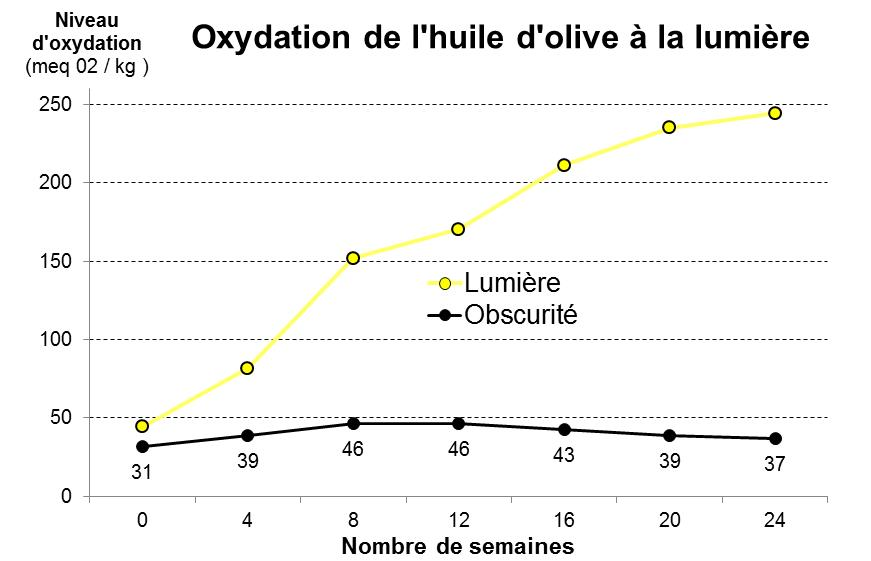
Light, however, destroys these antioxidants very quickly, which is why olive oil should always be kept in an opaque container. Studies by Dr A. K. Kiritsakis in the 1980s illustrate this well:

Shelf life
Olive oil gradually oxidises until it turns rancid. Even then it does not become unfit to eat, and consuming it causes no poisoning or illness. It has simply lost its sensory qualities and most of its health-giving minor components: it has no taste left, or a slightly unpleasant, rancid one. That is why olive oil carries a "best before" date rather than a "use by" date.
The main factors that speed up oxidation are light, air and heat. Left in full sun in an uncovered dish, oil can go rancid in less than a month. Under normal storage conditions, it keeps its sensory qualities for about two years after extraction on average. Normal storage conditions are:
- a temperature below 20 °C;
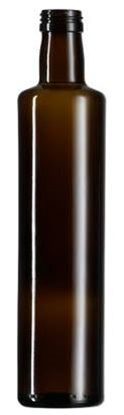
- a container, preferably glass, that is opaque to limit the oil's contact with light;
- a tightly closed container to limit contact with air.
EU rules in fact require the label to state storage conditions: "away from light and heat".
How long the sensory qualities and minor components last also depends on the olive varieties, the harvest date and the production process.
The closer to veraison (the change of colour) the olives are harvested, or just before it, the richer they are in antioxidants and the longer the oil keeps its flavour.
The less the olives and paste are exposed to light, air and heat (above 30 °C) during production, the longer the oil keeps its flavour. Oil from a continuous process, with horizontal and vertical centrifuges and decanting away from air, kept below 30 °C, therefore keeps longer than oil made by the old mat-press method.
Finally, some olive varieties contain far more antioxidants than others and, under the same harvesting, production and storage conditions, allow the oil to keep its flavour longer. This property is called oxidative stability; it is measured in the laboratory in hours at 98.8 °C. The Picual variety, for example, has one of the highest stabilities there is: a single-variety Picual oil can keep for up to four years under optimal conditions.